Lobby groups oppose plans for EU copyright extension
Licensed archive · Attributed source reporting
411 Brief
The European Commission currently has proposals on the table to extend performers' copyright terms. Described by Professor Martin Kretschmer as the "Beatles Extension Act", the proposed measure would extend copyright from 50 to 95 years after recording. A vast number of classical tracks are at stake; the copyright on recordings from the fifties and early sixties is nearing its expiration date, after which it would normally enter the public domain or become 'public property'. E.U. Commissioner for the Internal Market and Services Charlie McCreev
The European Commission currently has proposals on the table to extend performers' copyright terms. Described by Professor Martin Kretschmer as the "Beatles Extension Act", the proposed measure would extend copyright from 50 to 95 years after recording. A vast number of classical tracks are at stake; the copyright on recordings from the fifties and early sixties is nearing its expiration date, after which it would normally enter the public domain or become 'public property'. E.U. Commissioner for the Internal Market and Services Charlie McCreevy is proposing this extension, and if the other relevant Directorate Generales (Information Society, Consumers, Culture, Trade, Competition, etc.) agree with the proposal, it will be sent to the European Parliament.
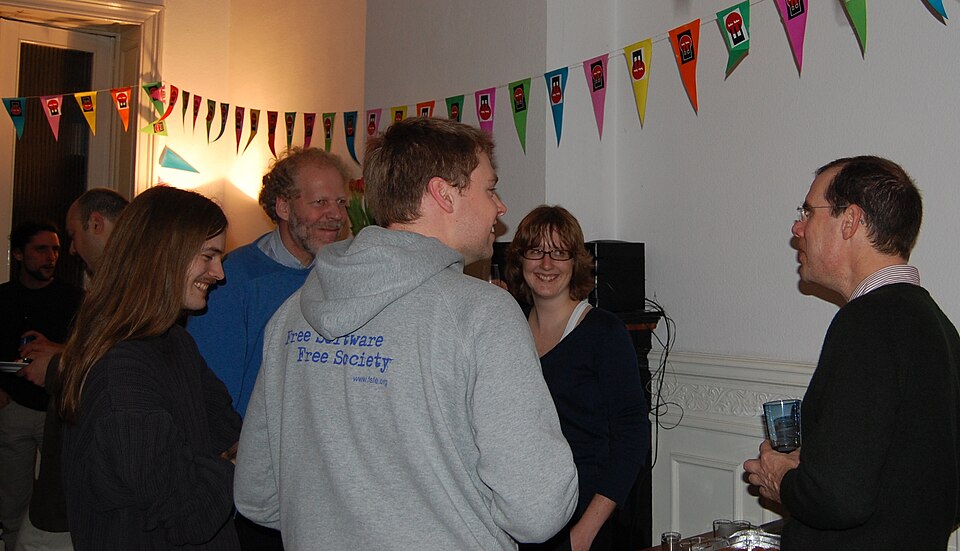
Wikinews contacted Erik Josefsson, European Affairs Coordinator for the Electronic Frontier Foundation (E.F.F.), who invited us to Brussels, the heart of E.U. policy making, to discuss this new proposal and its implications. Expecting an office interview, we arrived to discover that the event was a party and meetup conveniently coinciding with FOSDEM 2008 (the Free and Open source Software Developers' European Meeting). The meetup was in a sprawling city centre apartment festooned with E.F.F. flags and looked to be a party that would go on into the early hours of the morning with copious food and drink on tap. As more people showed up for the event it turned out that it was a truly international crowd, with guests from all over Europe.
Eddan Katz, the new International Affairs Director of the E.F.F., had come over from the U.S. to connect to the European E.F.F. network, and he gladly took part in our interview. Eddan Katz explained that the Electronic Frontier Foundation is "A non-profit organisation working to protect civil liberties and freedoms online. The E.F.F. has fought for information privacy rights online, in relation to both the government and companies who, with insufficient transparency, collect, aggregate and make abuse of information about individuals." Another major focus of their advocacy is intellectual property, said Eddan: "The E.F.F. represents what would be the public interest, those parts of society that don't have a concentration of power, that the private interests do have in terms of lobbying."
Becky Hogge, Executive Director of the U.K.'s Open Rights Group (O.R.G.), joined our discussion as well. "The goals of the Open Rights Group are very simple: we speak up whenever we see civil, consumer or human rights being affected by the poor implementation or the poor regulation of new technologies," Becky summarised. "In that sense, people call us -I mean the E.F.F. has been around, in internet years, since the beginning of time- but the Open Rights Group is often called the British E.F.F."
The interview
Cliff Richard's pension
Becky explained to us that she was in Brussels to gather support for a European movement against this proposal. She pointed out to us that compelling economic evidence shows that this measure will not help the E.U. single market, and she hopes that other Directorates will oppose it once they get wind of this fact. We asked Becky Hogge to tell us about the new proposal and why she thinks it is not a good idea.
Perpetual patents?
We raised the point that many common people also see copyright as a good thing and something that supports artists, while copyright violation has been said to have led to huge financial losses for the music industry.
We also noted that the term public domain seems to have a more profound meaning in the United States, and that many Europeans don't even know the term.
The fight moves from the U.K. to Europe
We asked Becky Hogge to tell us the history behind this proposal from a U.K. perspective.
Reclaiming democratic processes in the E.U.
Erik admitted he was disappointed when he compared the way laws are currently made in the European Union to his experience with Swedish politics.
Sources & reporting note
Licensed archive reporting by Wikinews contributors. Text: CC BY 2.5 (https://creativecommons.org/licenses/by/2.5/). Original source date retained. 411 has not independently verified this archive report.
Read the source: Wikinews ↗Source published 26 Feb 2008, 05:30 am IST