Newly discovered extra-solar planet may be Earth-like
Licensed archive · Attributed source reporting
411 Brief
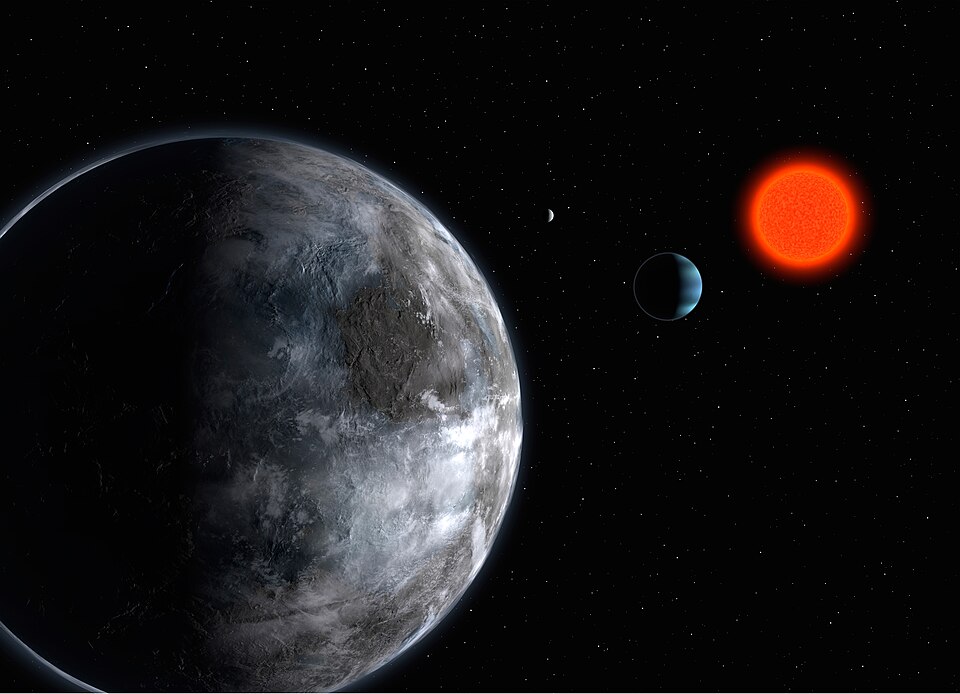
A planet 50% greater in radius and with about 5 times earth mass orbiting the red dwarf Gliese 581 has been discovered inside the constellation of Libra. A 2005 search revealed that the star Gliese 581 possessed a Neptune sized planet, prompting astronomers to take a closer look. Gliese 581 c, as the planet is aptly named, has an estimated surface temperature between 0 and 40°C (32 and 104°F). Scientists claim the planet is likely to have an atmosphere and liquid water. A second planet, about 8 times the mass of earth, was also discovered
A planet 50% greater in radius and with about 5 times earth mass orbiting the red dwarf Gliese 581 has been discovered inside the constellation of Libra.
A 2005 search revealed that the star Gliese 581 possessed a Neptune sized planet, prompting astronomers to take a closer look.
Gliese 581 c, as the planet is aptly named, has an estimated surface temperature between 0 and 40°C (32 and 104°F). Scientists claim the planet is likely to have an atmosphere and liquid water.
A second planet, about 8 times the mass of earth, was also discovered not too far from Gliese 581 c.
A team of scientists from France, Switzerland and Portugal discovered the planets using the ESO 3.6-m telescope from the High Accuracy Radial Velocity Planet Searcher or HARPS, located at the European Southern Observatory (ESO) in La Silla, Chile.
"The separation between the planet and its star is just right for having liquid water at its surface," said team spokesperson Stephane Udry of the Observatory of Geneva in Versoix, Switzerland. "That's why we are a bit excited."
"Liquid water is critical to life as we know it and because of its temperature and relative proximity, this planet will most probably be a very important [focus] of future space missions dedicated to the search for extra-terrestrial life. On the treasure map of the Universe, one would be tempted to mark this planet with an X," added Xavier Delfosse, from Grenoble University in France.
The newly discovered planet is 20.5 light-years away from the Earth.
Sources & reporting note
Licensed archive reporting by Wikinews contributors. Text: CC BY 2.5 (https://creativecommons.org/licenses/by/2.5/). Original source date retained. 411 has not independently verified this archive report.
Read the source: Wikinews ↗Source published 24 Apr 2007, 05:30 am IST