Protest held against Muhammad caricatures in Paris
Licensed archive · Attributed source reporting
411 Brief
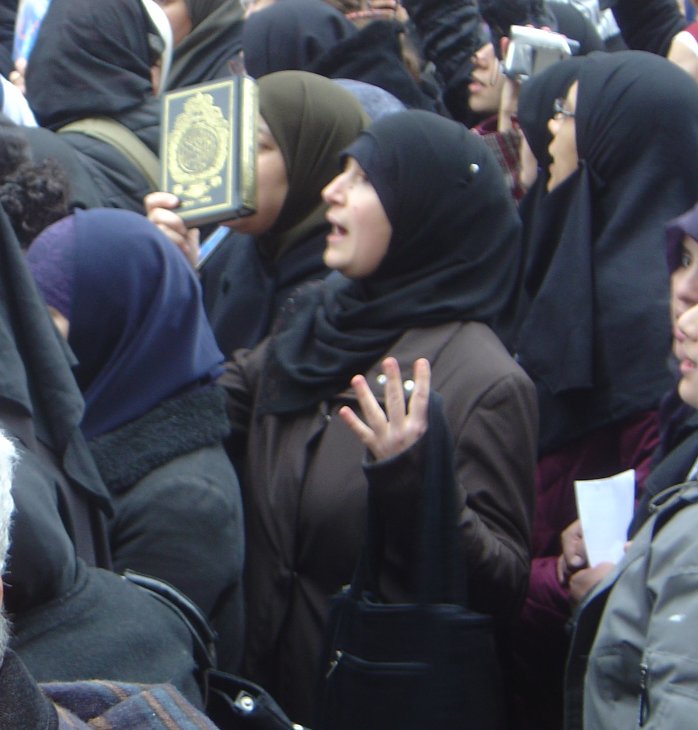
Several thousand Muslims protested today in Paris, France, as well as the eastern city of Strasbourg, against the publication of caricatures of the prophet Muhammad in a Danish newspaper and the re-publication of some of these caricatures in French newspapers: the daily France Soir and the weekly Charlie Hebdo. The protesters consider that these caricatures insulted their prophet, and thus, they contend, their religion and themselves. Charlie Hebdo is a weekly paper known for its extremely acerbic positions against organized religion; it often
Several thousand Muslims protested today in Paris, France, as well as the eastern city of Strasbourg, against the publication of caricatures of the prophet Muhammad in a Danish newspaper and the re-publication of some of these caricatures in French newspapers: the daily France Soir and the weekly Charlie Hebdo.
The protesters consider that these caricatures insulted their prophet, and thus, they contend, their religion and themselves. Charlie Hebdo is a weekly paper known for its extremely acerbic positions against organized religion; it often mocks Catholicism, the largest religious denomination in France.
Some banners claimed that freedom of speech should not imply the possibility of insulting religious figures. Other banners claimed that French society was applying dual standards. Some protesters demanded a law against "islamophobia"; France does not have blasphemy laws and has a tradition of anticlericalism.
Many of the female protesters wore a scarf to hide their hair, and some wore a hijab or veil. The French government enacted a law prohibiting conspicuous religious symbols in government-operated schools, a move widely considered to be targeting the veil and scarf, which many consider a sign of subordination of females.
The protest was organized by Muslim associations from the Paris region, most notably the Union of Muslim Associations from Seine-Saint-Denis. Seine-Saint-Denis, a département with a high proportion of immigrants, is notorious for social tensions. This is where the 2005 civil unrest started from.
In a related move, the French Council for Muslim Worship (CFCM), a private nonprofit considered by the French government to be its main contact with the Muslim community, is litigating against the newspapers, alleging the publication of the caricatures incited to religious hatred. Muslim associations attempted to prevent the publication of Charlie Hebdo, but their claim was rejected on procedural grounds.
The protest was followed at a distance by a large complement of CRS and other police forces. No notable incidents were mentioned.
Additional fake Jyllands-Posten cartoons circulating in the Middle East
In related news, it has come to attention that a number of additional cartoons not included in the Jyllands-Posten set may have had a role in bringing the issue to international attention. For example, three images which are reported to be considerably more obscene were portrayed in Gaza as if they had been part of the Jyllands-Posten set. One of the pictures, a photocopied photograph of a man with a pig's ears and snout, has been identified as an old Associated Press picture from a French "pig-squealing" contest, and makes no reference to Islam. It was reportedly circulated by Danish Muslims as if it was an anti-Islamic image. These and other images circulating around the Middle-East are partly responsible for much of the violent protest. The problem is being escalated by restrictions on the media in the Middle-East — for example, attempts to accurately portray the Jyllands-Posten cartoons and paint an accurate picture of the situation in the Jordanian media led to the arrest of two Jordanian editors, and the pulping of many newspapers before they were distributed.
Sources & reporting note
Licensed archive reporting by Wikinews contributors. Text: CC BY 2.5 (https://creativecommons.org/licenses/by/2.5/). Original source date retained. 411 has not independently verified this archive report.
Read the source: Wikinews ↗Source published 11 Feb 2006, 05:30 am IST