Researchers discover last common ancestor of apes and monkeys
Licensed archive · Attributed source reporting
411 Brief
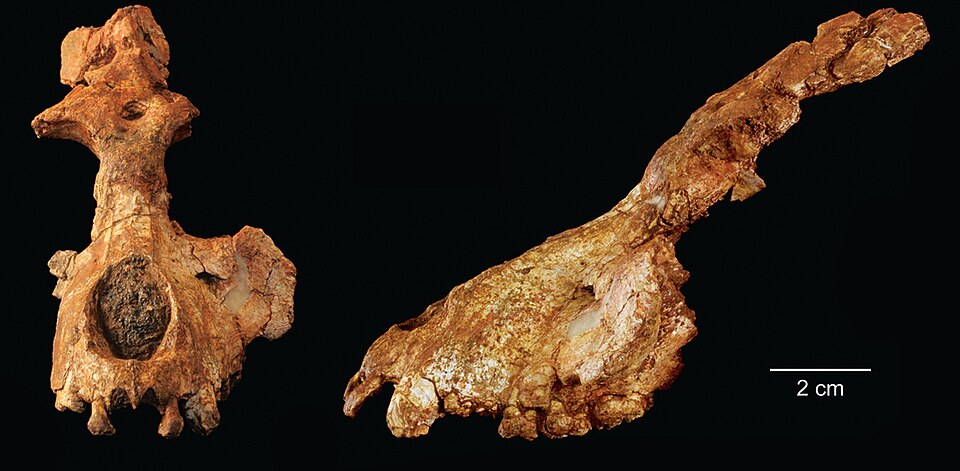
Researchers have unearthed a new fossil primate that they think may be closely related to the common ancestor of apes and Old World monkeys, collectively known as catarrhine primates. Paleontologist Iyad Zalmout of the University of Michigan discovered the new species, Saadanius hijazensis near Mecca in Saudi Arabia; the discovery gives new insights into human evolution. The specimen, a partial skull, dates to the Oligocene, approximately 29 to 28 million years ago, and exhibits puncture wounds from a large predator that may have killed it. S
Researchers have unearthed a new fossil primate that they think may be closely related to the common ancestor of apes and Old World monkeys, collectively known as catarrhine primates. Paleontologist Iyad Zalmout of the University of Michigan discovered the new species, Saadanius hijazensis near Mecca in Saudi Arabia; the discovery gives new insights into human evolution.
The specimen, a partial skull, dates to the Oligocene, approximately 29 to 28 million years ago, and exhibits puncture wounds from a large predator that may have killed it. Saadanius is thought to have been a tree-dweller and lived at a time when the Arabian peninsula had not yet split away from the African continent, forming the Red Sea. The discovery may help resolve the dating of the split between Old World monkeys and apes. Paleoanthropologists have traditionally dated the divergence to between 25 and 23 million years ago, based on early fossils of the two groups. Genetic studies, however, date it to between 30 to 35 million years ago.
Although Saadanius shares some features with living catarrhine primates, such as a bony ear tube, called an ectotympanic, it also possesses other features more common in the fossils of primitive or basal catarrhines, from which Old World monkeys and apes did not evolve. These basal features include a longer face and the lack of a frontal sinus.
Sources & reporting note
Licensed archive reporting by Wikinews contributors. Text: CC BY 2.5 (https://creativecommons.org/licenses/by/2.5/). Original source date retained. 411 has not independently verified this archive report.
Read the source: Wikinews ↗Source published 16 Jul 2010, 05:30 am IST