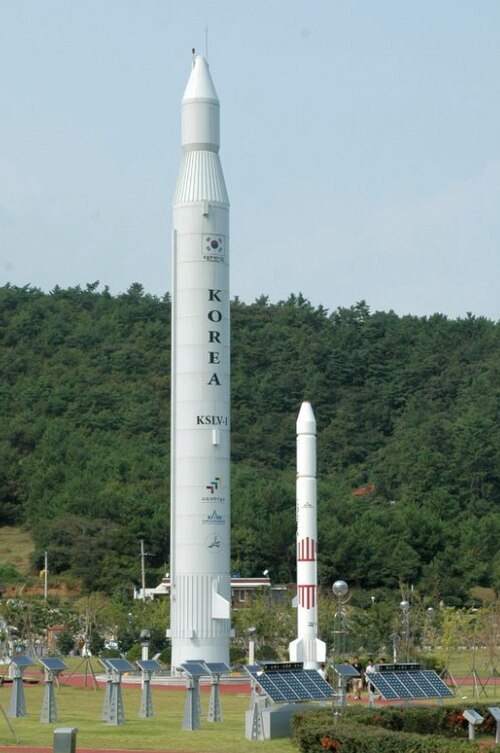
South Korean Naro-1 space rocket explodes after take-off
Licensed archive · Attributed source reporting
411 Brief
South Korea has lost contact with its Naro-1 rocket, just 137 seconds after take-off. Officials believe the rocket exploded. Korea Aerospace Research Institute (KARI) and Khrunichev State Research and Production Space Center had hoped to use a Naro-1, South Korea's first carrier rocket, to launch a STSAT-2B satellite. South Korea had postponed the launch on Wednesday due to problems with the rocket's fire extinguisher system. Science Ministry spokesman Pyun Kyung-bum said, "We expect that it will be difficult to launch today". The rocket lif
South Korea has lost contact with its Naro-1 rocket, just 137 seconds after take-off. Officials believe the rocket exploded.
Korea Aerospace Research Institute (KARI) and Khrunichev State Research and Production Space Center had hoped to use a Naro-1, South Korea's first carrier rocket, to launch a STSAT-2B satellite.
South Korea had postponed the launch on Wednesday due to problems with the rocket's fire extinguisher system. Science Ministry spokesman Pyun Kyung-bum said, "We expect that it will be difficult to launch today".
The rocket lifted off from Goheung's Naro Space Centre at 1701 (0801 GMT) today. The rocket apparently exploded 137 seconds after launch, when a flash was seen from an on-board camera and communication was lost. The loss of communication occurred when the rocket had achieved an altitude of around . Television cameras captured a white speck, presumably part of the rocket, falling into the sea.
Analysts say the failure is a setback for South Korea. If it had been successful, it would have been the first Naro-1 launch to reach orbit. The launch cost South Korea an estimated US$400 million, and if successful, would have launched a satellite called the STSAT-2B into orbit. The satellite was designed to examine climate change and its effects.
The incident is seen as a major setback for South Korea's space program, which had been aiming to become the 10th country to achieve the capability to launch satellites, and the fourth Asian country, after China, Japan, and India. A successful launch would have helped South Korea to become a player in commercial space launches, an industry valued at around US$250 billion.
Since 1992, South Korea has launched 11 satellites from overseas sites with foreign-made rockets.
Sources & reporting note
Licensed archive reporting by Wikinews contributors. Text: CC BY 2.5 (https://creativecommons.org/licenses/by/2.5/). Original source date retained. 411 has not independently verified this archive report.
Read the source: Wikinews ↗Source published 10 Jun 2010, 05:30 am IST