Final report blames London passenger jet crash on ice
Licensed archive · Attributed source reporting
411 Brief
The United Kingdom's Air Accidents Investigation Board (AAIB) yesterday blamed a release of ice in the fuel system of a British Airways passenger jet as the cause of a crash two years ago at London's Heathrow Airport. Flight 38 from China was attempting to land when both engines lost almost all power – a condition called "rollback". The exact phenomenon had never been previously identified, but it not only affected the British Airways jet two years ago but also a Delta Airlines jet above the United States later the same year. Both were Boeing
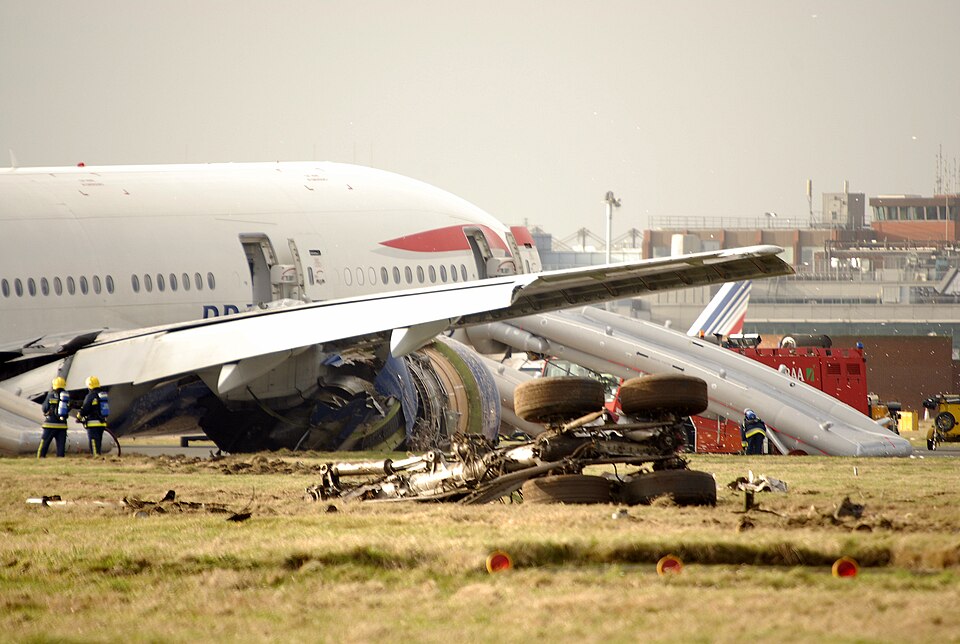
The United Kingdom's Air Accidents Investigation Board (AAIB) yesterday blamed a release of ice in the fuel system of a British Airways passenger jet as the cause of a crash two years ago at London's Heathrow Airport. Flight 38 from China was attempting to land when both engines lost almost all power – a condition called "rollback".
The exact phenomenon had never been previously identified, but it not only affected the British Airways jet two years ago but also a Delta Airlines jet above the United States later the same year. Both were Boeing 777 aircraft. That incident prompted the AAIB to collaborate with the US National Transportation Safety Board.
BA 38 was approximately 43 seconds from touchdown when it experienced a dual engine rollback that was beyond the control of the flight crew. Captain Peter Burkill and co-pilot John Coward were later hailed as heroes for performing a successful crash landing 330 metres from the runway. The plane avoided nearby buildings and a road, leaving the landing gear deployed to act as shock absorbers.
The jet slid 372 metres after the crash, but all 136 passengers evacuated alive. 36 passengers and twelve crewmembers were injured, mostly suffering whiplash and one incurring a broken leg. The report concluded there was no time to alert the cabin crew or passengers to the situation developing in the cockpit.
The engine rollback was caused by ice forming in the fuel system; the ice came from water molecules existing as impurities in the fuel, and lined the fuel system. When extra fuel was pumped through to supply the engines for landing manoeuvres, the ice was dislodged.
It is believed to have then settled on a component called the fuel-oil heat exchanger, a dual-purpose component that runs oil pipes through the fuel system. The idea is to cool down hot oil and keep fuel warm to prevent freezing. As the result of previous safety recommendations from both the UK and US investigators Boeing and engine company Rolls-Royce have worked to redesign the part.
Every component of the aircraft complied with all relevant airworthiness standards, and the fuel also complied with the standards applying to it. Although ice problems have been known since the 1950s, sudden release problems were unheard of before the crash. The testing conducted as part of the investigation is thought to be unique and the aircraft experienced unusually low temperatures during the flight.
A total of eighteen safety recommendations have been issued, of which nine came from an interim report and nine are new. Some of these apply to aircraft "crashworthiness" – the ability to withstand impact forces.
Sources & reporting note
Licensed archive reporting by Wikinews contributors. Text: CC BY 2.5 (https://creativecommons.org/licenses/by/2.5/). Original source date retained. 411 has not independently verified this archive report.
Read the source: Wikinews ↗Source published 10 Feb 2010, 05:30 am IST