Discovery of smallest exoplanet yields 'extraordinary' find
Licensed archive · Attributed source reporting
411 Brief
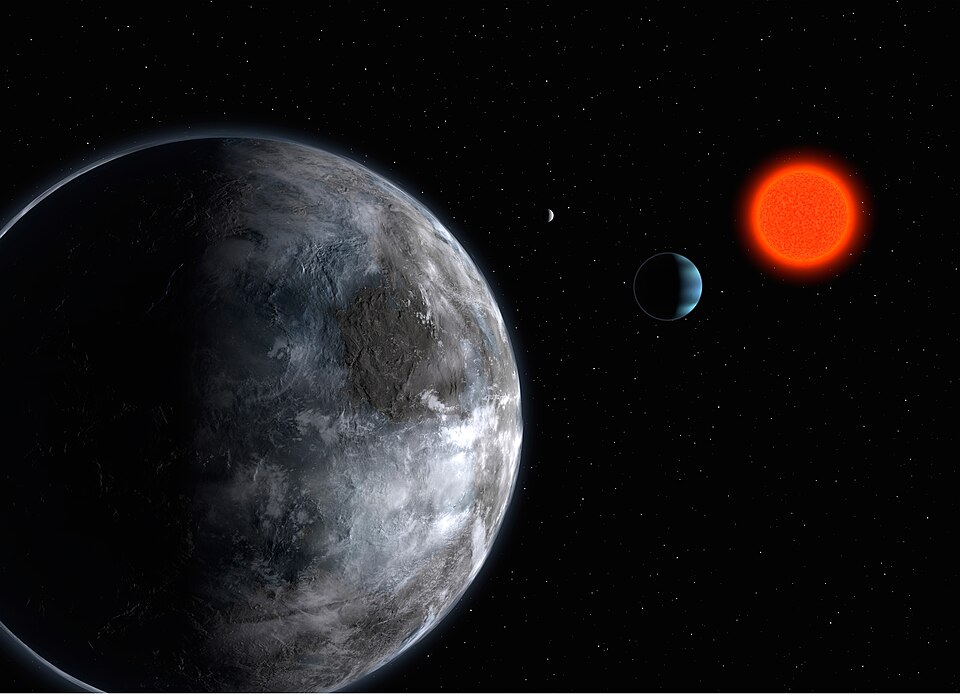
Scientists have made two major discoveries in the search for other Earth-like planets. British astronomers say they have discovered the smallest known Earth-like exoplanet orbiting a living star called Gliese 581 e and also discovered that a nearby planet called Gliese 581 d, discovered in 2007, is in the much sought after 'habitable zone'. Astronomers also believe there is a possibility that 581 d could have liquid oceans on its surface, calling the find "extraordinary." "The Holy Grail of current exoplanet research is the detection of a rock
Scientists have made two major discoveries in the search for other Earth-like planets. British astronomers say they have discovered the smallest known Earth-like exoplanet orbiting a living star called Gliese 581 e and also discovered that a nearby planet called Gliese 581 d, discovered in 2007, is in the much sought after 'habitable zone'. Astronomers also believe there is a possibility that 581 d could have liquid oceans on its surface, calling the find "extraordinary."
"The Holy Grail of current exoplanet research is the detection of a rocky, Earth-like planet in the 'habitable zone'," said astrophysicist at Switzerland's Geneva University, Michel Mayor.
Astronomers say 581 e is 20.5 light years away from Earth and that it's roughly 1.9 times larger than Earth, making it the smallest exoplanet discovered to date. It was found using the High Accuracy Radial Velocity Planet Searcher (HARPS). It orbits too close to its parent star, Gliese 581, which would make it too hot, unable to support life as we know it. It takes just over 3 days for it to orbit the star.
Exoplanet 581 d, however, is another story. Astronomers say this makes it possible to not only support life, but have liquid water in the forms of oceans. 581 d is approximately 7.7 times larger than Earth. Astronomers originally thought it was too cold to have liquid water thus would not be able to host Earth-like life.
"It is very exciting that such a promising candidate for an Earthlike planet has been found so close to us. It means there are likely to be many more when we search further," added Mayor.
Sources & reporting note
Licensed archive reporting by Wikinews contributors. Text: CC BY 2.5 (https://creativecommons.org/licenses/by/2.5/). Original source date retained. 411 has not independently verified this archive report.
Read the source: Wikinews ↗Source published 21 Apr 2009, 05:30 am IST